 A story from Bede’s medieval history of England suggests that our lives are like a hall in the dead of winter; a roaring fire fills the space with warmth and light, while a snowstorm rages outside. Occasionally a sparrow flits into the hall searching for refuge from the cold, but almost as quickly it returns to the storm again. “‘So this life of man appears for a little while,’” recounts the storyteller, “‘but of what is to follow or what went before we know nothing at all.’”1Bede, Ecclesiastical History of England, trans. A. M. Sellar (London: George Bell and Sons, 1907), 117. This was the attitude of the British people, from before the time of Bede and especially through the reign of Queen Victoria. While most of us spend our entire lives within our comfortable halls, the sparrow brings a clue of something beyond—an adventure awaiting exploration. Victorian literature and history explores this adventurous spirit, as heroes venture forth into the tempest to conquer exotic dangers in faraway places.
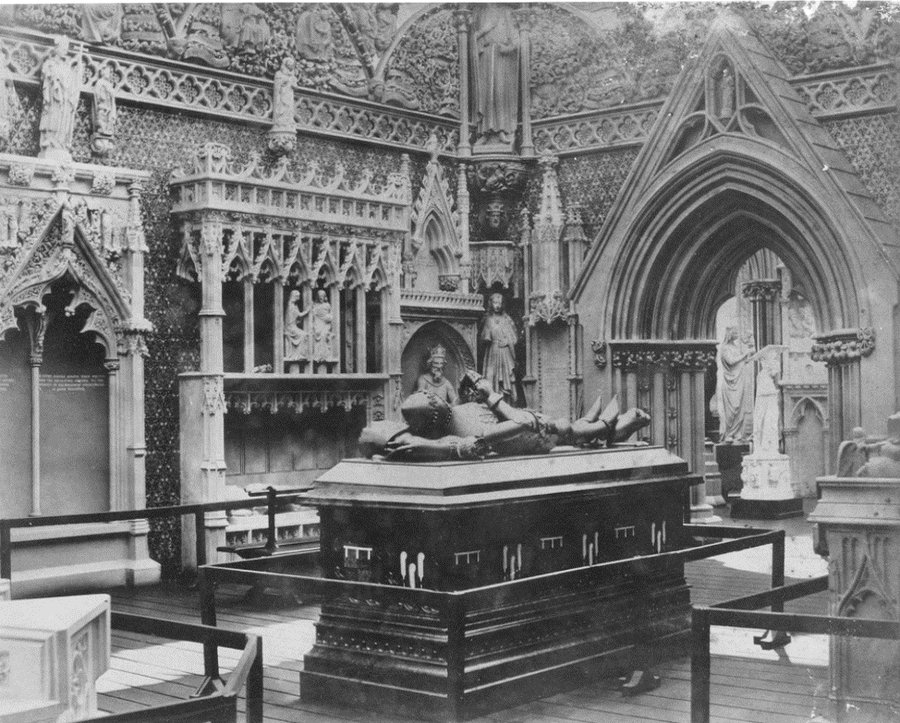
There is no better example of this medievalist spirit than at the Crystal Palace exhibition of 1851; here, visitors could wander through an elaborate recreation of a medieval court, experiencing the extravagance and wealth of the medieval kings of England, and absorbing the spirit of an age long forgotten. Towering religious figures loomed above the entrance, guarding tombs and effigies displaying kings, queens, bishops, and lords long dead for almost 1500 years. Surrounding these grim monuments was remarkable recreated Gothic architecture, displaying the rich detail with which medieval artists expressed their devotion to god and king.2M. Digby Wyatt and J. B. Waring, The Mediæval Court In the Crystal Palace (London: Crystal Palace Library and Bradbury & Evans, 1854), 36–67. This image evokes that very same medieval hall from Bede’s history.
But the influence of Victorian medievalism extended beyond just the artistic and aesthetic. The nineteenth century witnessed the golden age of the British Empire, “on which the sun never set”, and with the rise of such a powerful and influential state came also the need to forge a unifying cross-cultural national identity. It was at the Crystal Palace, with its adventurous international displays and emphasis on British industrial and cultural superiority, that this identity went on full display. The medieval court exhibit acted as a demonstration of Britain’s connection to their past, and of the applicability of medievalist attitudes to a burgeoning empire; it was also the product of decades of revitalized interest in medieval literature, particularly the legends of King Arthur and his Knights of the Round Table. The popularity of King Arthur came as a response to increasing tension both at home and abroad over imperial power, and the legendary king and his chivalrous knights provided the perfect example for Britons to admire. These stories helped inspire the British people to be like the sparrow, venturing forth into the unknown in service of their queen and country. But at the same time, they also revealed that many of the pressing issues were not unfamiliar to the British people, but were symptomatic of a long history of exploitation and expansion.
While the nineteenth century saw the emergence of many folk heroes (including Robin Hood) the legend of King Arthur had a long history of political usage. He was first mentioned by several ancient Welsh chronicles in the seventh century, and by the twelfth century the historian Geoffrey of Monmouth had transformed him from a Celtic warlord into his modern form, as the powerful British king. He would become associated with and revered by the elite, with this new identity initially being used to justify the Norman conquests, linking his Welsh heritage to the Arthurian romances of France.3Stephanie L. Barczewski, Myth and National Identity in Nineteenth-Century Britain: The Legends of King Arthur and Robin Hood (Oxford: Oxford University Press, 2000), 14–15.
The political uses of King Arthur would continue after the Hundred Years’ War and the Wars of the Roses, as Britain attempted overcome political chaos and create order out of an admired past.4Barczewski, Myth and National Identity, 16. This was exemplified in Sir Thomas Malory’s Le Morte d’Arthur (1485), although it would not hit its zenith until the reign of the Tudor dynasty in England; Henry VII would draw on his Welsh ancestry and its connection with Arthur to justify his seizure of the British crown in 1485, even naming his eldest son Arthur, “to evoke memories of that legendary British King”,5J.H. Plumb, Frederic A. Youngs Jr., Henry L. Snyder, E.A. Reitan, and David M. Fahey, The English Heritage (St. Louis: Forum Press, 1978), 91. marrying him to Catherine of Aragon. Even Winchester came to be identified as the location of the legendary Camelot.6John A. Wagner and Susan Walters Schmid, Encyclopedia of Tudor England, 3 vols. (Santa Barbara, CA: ABC-CLIO, 2012), 1104. But Arthur would die, and his brother Henry would ultimately marry Catherine of Aragon and become king of England. Henry VIII would bring a thirteenth century “round table”, painted in the Tudor colors of green and white, to his court in Winchester, while Elizabeth I’s propagandists frequently used Arthurian imagery—including one drama where the Virgin Queen saved the wizard Merlin from being imprisoned by the Lady of the Lake, and also sponsored the release of Edmund Spenser’s work The Faerie Queene (1590–6), set in a righteous world of chivalry.7Plumb et al., The English Heritage, 117. Similarly, James I capitalized on the myth by appealing to his Scottish ancestry, claiming that his reign would fulfill Merlin’s ancient prophecy of a union between England and Scotland. With the defeat of the monarchists during the English Civil War, the noble chivalry of King Arthur fell out of style. In one prominent case, England’s leading poet John Milton decided to abandon an epic poem about the legendary king, opting instead to choose the Book of Genesis as his subject—becoming a severe opponent to the elitism of Arthur and the monarchy.8Barczewski, Myth and National Identity, 17–18.
The British came to view the Middle Ages as a beautiful and romantic period, comparable to the modern day through its negative contrast. The emergence of modern factory wage-slaves even produced a nostalgic longing for the days of the serfs.9Barczewski, Myth and National Identity, 27. The first of the famous attempts to paint King Arthur as a direct link to the modern age came from Sir Richard Blackmore’s two poems, Prince Arthur (1695) and King Arthur (1697), which painted the legendary ruler as a “staunch Whig and a devout Protestant”10Ibid., 28. and explicitly compared him to King William III:
Soon did the Britons see a peaceful Bay
To guard their Ships her spacious Arms display.
Where weary Billows did securely sleep
Withdrawn to shun the Tumults of the Deep.
Within the winding Shores they safely past
Took in their Sails, and all their Anchors cast.11Richard Blackmore, King Arthur: An Heroick Poem in Twelve Books (London: Awnsham and John Churchil, 1697).
In the following centuries, stories from the Arthurian legend would be used particularly in the context of military victories and as hope during periods of failure, as constant warfare provoked a need for a poetic justification of the British martial attitude.
The French Revolution further encouraged the medievalist revival in Britain. While the French were viewed as tossing away the old systems and replacing it with abstract and speculative theories, the British capitalized on practical order, built on hundreds of years of historical evolution. King George III even abandoned his preferred neoclassical style of architecture in favor of a return to Gothic style following the French Revolution; the king built an entirely new castle featuring “turrets, moats, arrow windows, and a battlemented gatehouse”12Barczewski, Myth and National Identity, 33.—a structure which was satirically referred to as “the Bastille”. Suddenly, the decadence and nobility of King Arthur became immensely appealing to the British elite. The Bridal of Triermain (1813) by Sir Walter Scott would be the first major work of Arthurian literature produced in almost a century. The Duke of Wellington, Arthur Wellesley, even became known by many as the re-embodiment of King Arthur, returning to aid the British Empire in their time of need against the French. J.H. Merivale wrote in Orlando in Roncesvalles (1814): “Sleeps Arthur in his isle of Avalon? / High-favour’d Erin sends him forth once more / To realize the dream of days far gone.”13John Herman Merivale, Orlando in Roncesvalles (London: Richard and Arthur Taylor, 1814), 91. Arthur was rarely compared to another military leader after 1815.14Barczewski, Myth and National Identity, 39.
Although the legends of King Arthur had historically been associated with both Wales and the border between England and Scotland, during the nineteenth century the stories became linked to the southwest, in Cornwall, which boasted the site of Arthur’s birth at Tintagel Castle and his death at Camelford, along with several other sites associated with the legends. As Cornwall became associated with the Arthurian legends, they began to adapt aspects of Cornish culture—the sea suddenly became a central theme in stories written by Charles Bruce, Alfred Tennyson, and Algernon Charles Swinburne.15Barczewski, Myth and National Identity, 202–207. This relationship to the sea served to strengthen Britain’s nautical heritage, and contextualize their imperial expansion through naval supremacy. In an anonymous story titled Arthur’s Knights: An Adventure from the Legend of the Sangrale (1859), Sir Galahad remarks before beginning his search for the Holy Grail:
Through earth’s dark caves and mountain hollows roam,
Hasten, through purling brook and rushing river,
Back to the sea—their home?
Their home where all earth’s changes cease to be,
The rest of perfect life, the wide and ancient sea!16Anonymous, Arthur’s Knights: An Adventure from the Legend of the Sangrale (Edinburgh: R. & R. Clark, 1859).
While the legends of King Arthur and the sea became intertwined with support of imperial expansion, characters like the staunchly individual Robin Hood became the symbol of a burgeoning faction opposed to these foreign conflicts.
By 1851 and the Crystal Palace exhibition, the legends of King Arthur had become fully ingrained in the hearts and minds of the British public. Besides the copious amounts of literature being produced over the course of the century (which was the single biggest means of propagation during the time),17Barczewski, Myth and National Identity, 52. the legends were used throughout various other popular entertainment mediums; racehorses popped up named after figures like Arthur and Guinevere, affluent Britons dressed up as the characters to attend parties, scenes painted from the various stories became radically popular, gothic architecture and furniture inspired by the time period became a symbol of wealth and taste, and even pubs were named in reference to the mythological stories and characters.18Ibid., 52–56.
The quest for the Holy Grail came to represent the growing fear for the success of imperial ambitions. In the story, King Arthur sends his knights out into the wilderness to search for the Holy Grail; one by one the knights are defeated by their own sinfulness, all except Galahad. With the loss of so many soldiers, Arthur’s great kingdom is destroyed—mirroring a common worry from the British public about imperial overextension in the late nineteenth century.19Barczewski, Myth and National Identity, 217–219.
Sir Perceval and Sir Galahad were most commonly invoked as exemplars for the modern knight of the empire, and were also the only knights of King Arthur pure enough to complete the quest for the Holy Grail. Neither these characters nor the Grail quest were popular prior to the Indian Mutiny of 1857 (an event which shook the unshakable spirit of the Empire), but following the event they became ideals for the modern Victorian man devoted to the cause of empire. However, the isolated young man dying for an empire also began to convey the negative connotation of meaningless sacrifice in pursuit of imperial conquests.
Cultural historians have identified in Victorian literature a new concept of masculinity which reformulated the image of bravery, loyalty, courtesy, generosity, modesty, purity, and compassion… this chivalric ethos served as a code of colonial conduct which functioned to distinguish the British from the ostensible barbarities of the societies over which they ruled.20Barczewski, Myth and National Identity, 220.
While authors of Arthurian inspired stories began to prophesize the doom of an overextended empire, they never questioned its virtue; imperialism served to civilize the otherwise barbaric portions of the world, and conquest would bring prosperity. In contrast, the legend of Robin Hood was used to oppose imperialism, instead encouraging focus on domestic issues.
It was this call to adventure that resounded so heavily with the British public, especially as the great British Empire continued to spread to all corners of the world. Like the sparrow darting into the warm Anglo-Saxon hall of Bede’s medieval history, bold adventurers and courageous military officers brought tales of honor and glory from dangerous faraway lands, hoping to lure other aspiring boys towards adventures worthy of a knight of the Round Table.
Part of this transformation included the necessary “otherizing” of certain groups—notably colonial subjects such as the Indians, Africans, and Chinese. Previously, groups such as the Scottish and Welsh were considered foreigners in their own nation, but now these groups could unite in a common sense of “Britishness”, compared to the even more exotic foreigners of Africa and Asia. This fear of the “other” was very prominent during the planning of the Great Exhibition; in the months preceding the fair, news outlets were publishing columns on the expected increase of foreigners in London. Most of these predictions were pessimistic and outright xenophobic, with prominent figures expressing doubt over the safety of the event. According to census data, the actual number of non-European foreigners entering the city in 1851 was much below expectation, and there was “not a single episode of trouble” throughout the entire event.21Jeffrey A. Auerbach, The Great Exhibition of 1851 (New Haven: Yale University Press, 1999), 185. 110 of these were Chinese, and only 78 were considered “foreign”.22Auerbach, The Great Exhibition of 1851, 186. These attempts to create an international identity, in tandem with the personal British identity, seemed to have been mired by several events leading up to and following the event, including an invasion scare, “Papal Aggression”, an upsurge of Russophobia, and the rise of Louis Napoleon in 1852.
Over the course of these centuries, from the reigns of Henry VII to Victoria, the image of the noble King Arthur and his chivalrous knights became chiefly associated with the elite aristocracy. The working class found an icon in humbler characters such as Robin Hood, although the image of the just and benevolent king would not have been so effective had many of the common people not revered the attributes of the nobility; individuals aspired to reach the status and posture of the noble king and his knights, or found comfort in the belief that their own rulers were descended from the same blood of great men such as King Arthur.
The organizers of the Great Exhibition of 1851 wanted to capitalize on the power and influence of the British Empire, and set out to display the strength of a unified British identity through the exhibits at the Crystal Palace. However, those organizers struggled to create a genuine representation of the national spirit—mainly due to internal identity issues. Upon introducing the fair, Prince Albert declared that it would be a festival of peace, where individuals of different heritages could be united under a global identity.23Auerbach, The Great Exhibition of 1851, 161. This internationalist attitude was shared by the Manchester industrialist Richard Cobden, although it was opposed by a much stronger nationalist faction led by Lord Palmerston, whose strong political influence proved more effective than the wildly optimistic (in the eyes of the British public) internationalist view. The view of Britain as a protective and just agent in global affairs was popular, and Edward Bulwer Lytton’s poem King Arthur (1849) presents this attitude:
Mild, like all strength, sits Crowned Liberty,
Wearing the aspect of a youthful Queen:
And far outstretch’d ’long the unmeasured sea
Rests the vast shadow of her throne; serene
From the dumb icebergs to the fiery zone,
Rests the vast shadow of that guardian throne.24Edward Bulwer Lytton, King Arthur (London, 1849), 21, 29.
Thus we finally come to the Great Exhibition of 1851—the first international exhibition, putting on a display to emphasize the increasingly globalized world of the nineteenth century. It was dominated by the British Empire and their colonial holdings, as can be expected, and this display served as a demonstration of the might of the British Empire in comparison to the nations of Western Europe and the other, often antiquated, global powers. This was specifically done by demonstrating the new mechanical technology which was being developed in Britain, and a large portion of the fair was devoted to machinery instruction (as a means of educating the local British population on how to be more productive workers). However, these smaller purposes often ballooned into much larger effects.
While many of the European governments were enthusiastic about participating in this demonstration of their own local power, others were not. The Polish consulate expressed pessimism for the possibility of such a project, while the minister in Berlin had trouble organizing the separate German states into creating exhibits.25Hermione Hobhouse, The Crystal Palace and the Great Exhibition (London: Continuum, 2002), 45. These exhibits, featuring multiple powers from throughout Europe and the world, seemed to be competing for their influence (ultimately dwarfed by the British); medals were even given for meritorious exhibits.
The English medieval court (which was described previously) would be the most obvious symbol of influence from the Arthurian legends. Drawing on the historical architectural realities, the artifacts in the room spanned centuries, and were more meant to convey an overall medieval “spirit,” decadent in its splendor. It hearkened back to the days of Arthur and his knights, and of the great English monarchs who descended from his ilk. The court was especially decorated with statues and tombs of influential clerics and saints, demonstrating the historical piety of the English kings. This piety even seemed to cause controversy, with the leading Evangelical reformer Lord Ashley complaining of a crucifix displayed in the court.26Hobhouse, The Crystal Palace, 68.
The entire structure was a testament to the power of British ingenuity. The so-called “Crystal Palace” was essentially a massive greenhouse, being made of glass, and featured over 100,000 exhibits and nearly 14,000 exhibitors, half of which were foreign.27Ibid., 66. Its size served, firstly, as a method of demonstrating the cooperation of the British with foreign powers in improving the world, and also by demonstrating the reach of the “empire upon which the sun never sets.” Throughout the coming decades, Britain would continue to expand their global reach more and more, until finally releasing their colonies following the Second World War. For a long time it seemed as though Merlin’s prophecy had been right; beginning with the gradual unification of the British Isles, and ending with a unified world under the banner of St. George and England. But mythologies are just that, myths.
The rapid expansion into foreign territories opened boundless opportunities for the people of Britain, both in the colonies and back home on the islands. With the advent of advanced transportation technology, and increased productivity due to mechanical innovations, the British people were opened up to a world of imagination—increased productivity led to more leisure time, more leisure time led to more reading, and more reading meant more exposure to the epic Arthurian poetry which became so common during the period.
As the British people were exposed once again to the stories and adventures of their past, there was a rebirth in the values espoused by its characters. Suddenly, the newly-exposed exotic world was attractive to a curious mind, and the British public longed for adventure.28Tim Jeal, Explorers of the Nile: The Triumph and the Tragedy of a Great Victorian Adventure (New Haven: Yale University Press, 2008). Like the knights of King Arthur’s court, the British people could travel beyond their safe and civilized homes into the unknown, to confront danger in service of god and country. I am reminded of the famous poem The White Man’s Burden (1899) by Rudyard Kipling, where the British (or, more generally, Western) man is called forth to be the agent of positive change in the world:
Take up the White Man’s burden—
No tawdry rule of kings,
But toil of serf and sweeper—
The tale of common things.
The ports ye shall not enter,
The roads ye shall not tread,
Go make them with your living,
And mark them with your dead.
It would become the burden of the British people, driven by adventure and a desire to improve and shape humanity, who would venture forth to continents like Africa, America, or Asia to brave the perils of godless savages and other untold dangers, purely because they must. This was the unifying factor of all men on the Isles. They were not unified by race, nor nationality, nor political affiliation, but rather by their dedication to a single purpose. Whether this single purpose was justified, or even true, is another matter—it is clear that the British people believed in this vision, and saw themselves as its executor.
It was, then, at the Great Exhibition of 1851 where this vision took shape. Surrounded by glorious, modern riches from around the globe, it is impossible to not grasp the size of British influence. In such a time of change, it was necessary for the British public to cling to their past like a rock, firm in their foundations regardless of the uncertain future ahead.
Endnotes
- Bede, Ecclesiastical History of England, trans. A. M. Sellar (London: George Bell and Sons, 1907), 117.
- M. Digby Wyatt and J. B. Waring, The Mediæval Court In the Crystal Palace (London: Crystal Palace Library and Bradbury & Evans, 1854), 36–67.
- Stephanie L. Barczewski, Myth and National Identity in Nineteenth-Century Britain: The Legends of King Arthur and Robin Hood (Oxford: Oxford University Press, 2000), 14–15.
- Ibid., 16.
- J.H. Plumb, Frederic A. Youngs Jr., Henry L. Snyder, E.A. Reitan, and David M. Fahey, The English Heritage (St. Louis: Forum Press, 1978), 91.
- John A. Wagner and Susan Walters Schmid, Encyclopedia of Tudor England, 3 vols. (Santa Barbara, CA: ABC-CLIO, 2012), 1104.
- Plumb et al., The English Heritage, 117.
- Barczewski, Myth and National Identity, 17–18.
- Barczewski, Myth and National Identity, 27.
- Ibid., 28.
- Richard Blackmore, King Arthur: An Heroick Poem in Twelve Books (London: Awnsham and John Churchil, 1697).
- Barczewski, Myth and National Identity, 33.
- John Herman Merivale, Orlando in Roncesvalles (London: Richard and Arthur Taylor, 1814), 91.
- Barczewski, Myth and National Identity, 39.
- Barczewski, Myth and National Identity, 202–207.
- Anonymous, Arthur’s Knights: An Adventure from the Legend of the Sangrale (Edinburgh: R. & R. Clark, 1859).
- Barczewski, Myth and National Identity, 52.
- Ibid., 52–56.
- Barczewski, Myth and National Identity, 217–219.
- Ibid., 220.
- Jeffrey A. Auerbach, The Great Exhibition of 1851 (New Haven: Yale University Press, 1999), 185.
- Auerbach, The Great Exhibition of 1851, 186.
- Auerbach, The Great Exhibition of 1851, 161.
- Edward Bulwer Lytton, King Arthur (London, 1849), 21, 29.
- Hermione Hobhouse, The Crystal Palace and the Great Exhibition (London: Continuum, 2002), 45.
- Hobhouse, The Crystal Palace, 68.
- Ibid., 66.
- Tim Jeal, Explorers of the Nile: The Triumph and the Tragedy of a Great Victorian Adventure (New Haven: Yale University Press, 2008).
Bibliography
- Auerbach, Jeffrey A. The Great Exhibition of 1851: A Nation on Display. New Haven: Yale University Press, 1999.
- Barczewski, Stephanie L. Myth and National Identity in Nineteenth-Century Britain: The Legends of King Arthur and Robin Hood. Oxford: Oxford University Press, 2000.
- Bede. Bede’s Ecclesiastical History of England. Translated by A. M. Sellar. London: George Bell and Sons, 1907.
- Blackmore, Richard. King Arthur: An Heroick Poem in Twelve Books. London: Awnsham and John Churchil, 1697.
- Hobhouse, Hermione. The Crystal Palace and the Great Exhibition. London: Continuum, 2002.
- Hoffenberg, Peter H. An Empire on Display: English, Indian, and Australian Exhibitions from the Crystal Palace to the Great War. Berkeley: University of California Press, 2001.
- Holloway, Lorretta M., and Jennifer A. Palmgren, eds. Beyond Arthurian Romances: The Reach of Victorian Medievalism. New York: Palgrave Macmillan, 2005.
- Jeal, Tim. Explorers of the Nile: The Triumph and the Tragedy of a Great Victorian Adventure. New Haven: Yale University Press, 2008.
- Merivale, John Herman. Orlando in Roncesvalles. London: Richard and Arthur Taylor, 1814.
- Plumb, J.H., Frederic A. Youngs Jr., Henry L. Snyder, E.A. Reitan, and David M. Fahey. The English Heritage. St. Louis: Forum Press, 1978.
- Wagner, John A., and Susan Walters Schmid. Encyclopedia of Tudor England. 3 vols. Santa Barbara, CA: ABC-CLIO, 2012.
- Wyatt, M. Digby, and J. B. Waring. The Mediæval Court In the Crystal Palace. London: Crystal Palace Library and Bradbury & Evans, 1854.