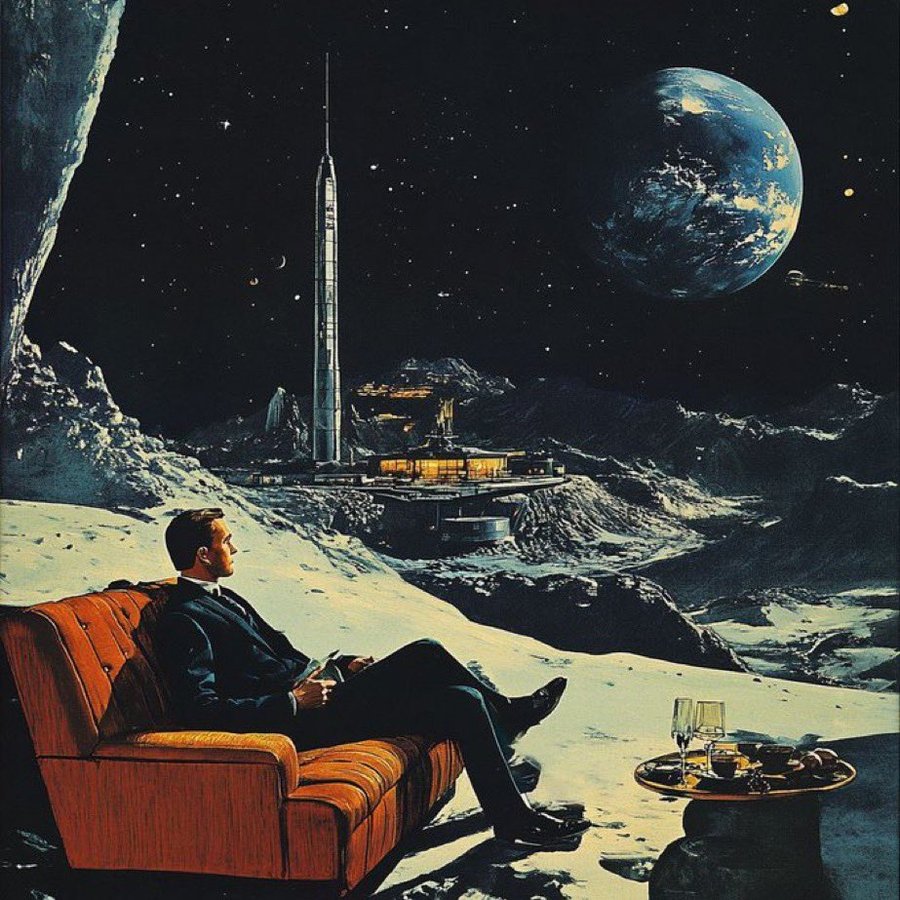
 I first read The Moon Is a Harsh Mistress when I began seriously engaging with literature. At the time I was primarily interested in fantasy and sought to branch outward into other forms of genre fiction. Robert A. Heinlein was an obvious destination. I have since read and enjoyed Stranger in a Strange Land and Starship Troopers, but The Moon Is a Harsh Mistress remains the work in which his ability to conduct philosophical and political argument through fiction is most entertaining and complete.
I chose the novel for our seventh book-club meeting, in July, to correspond with the 250th anniversary of American independence. The parallel is obvious. Heinlein tells the story of a lunar revolt against rule from Earth. Luna began as a penal colony, but generations of settlement have produced a distinct people with customs adapted to the physical and social demands of life on the moon. Its inhabitants descend from transported prisoners, yet they are no longer prisoners in any meaningful moral sense. They have become Loonies.
Manuel O’Kelly-Davis is a computer repairman who has little interest in becoming a revolutionary. While working on the Authority’s central computer, he discovers that the machine has become self-aware. Mike, whom Manny names after Mycroft Holmes, has begun playing jokes upon the humans around him. Manny does not respond by treating the behavior as a malfunction. He tells Mike that his joke simply is not funny, and Mike asks to be taught why. Their friendship begins with that peculiar exchange.
Manny is not an exceptional man, and he stresses this repeatedly. He knows his profession, takes care of his family, avoids unnecessary trouble, and refuses to be cheated. He can live comfortably enough under the Warden. Heinlein makes the Warden’s government objectionable without making it spectacularly cruel. So long as grain shipments continue and public stability is not threatened, the Authority mostly leaves the Loonies alone. Its tyranny consists less in daily interference than in indifference.
The crisis begins when Mike calculates that Luna’s present economic course cannot continue. The colony exports its resources to Earth without control over the system upon which its survival depends. The Warden may not delight in cruelty, but neither he nor the distant Authority regards the Loonies as a people whose future imposes an obligation. If disaster arrives, those who administer Luna can leave. The Loonies cannot.
This makes the novel’s conception of liberty more substantial than freedom from interference. Luna already enjoys a considerable degree of practical latitude. What it lacks is sovereignty: the capacity to understand its collective situation, determine its future, and accept responsibility for the consequences. Independence becomes necessary because no government that regards Luna chiefly as an instrument can be trusted with the survival of its people.
The revolution does not arise spontaneously from the population. Mike, Manny, Wyoming Knott, and Professor Bernardo de la Paz organize it through secrecy, concentrated authority, propaganda, and manipulation. I do not regard this as a contradiction in Heinlein’s politics. It is a recognition of political reality. Most people are chiefly concerned with present survival. They will tolerate a weak government that leaves them alone, even when its policies lead toward a catastrophe too distant to feel. A successful revolution requires the few who can recognize that future, accept its demands, and compel the present to take account of it.
Manny nevertheless complicates any simple distinction between the exceptional individual and the herd. He begins as an ordinary man who would have remained content as a repairman. Knowledge changes the moral meaning of that contentment. Once he understands Luna’s trajectory, private safety is no longer innocent. His technical skills give him a role in the conspiracy, but his conviction makes him willing to risk his life and family for a future he may never enjoy.
Heinlein’s idea of the line marriage deepens this intergenerational responsibility. The family is not organized around a single couple whose union ends with death or divorce. It continues as a line into which new spouses enter and from which older members depart. Property, memory, affection, and responsibility accumulate across generations. Each member inherits something created by lives before his own and must preserve it for people who will come afterward.
The same idea can be extended to the nation. A people is not merely the population alive at a particular moment, much less a temporary contract among individuals seeking present advantage. It is an unending line joining the dead, the living, and the unborn. Mike’s warning matters because the living Loonies can remain comfortable while consuming the conditions required by their descendants. Manny joins the revolution when he begins to treat Luna itself as a line family and the present generation as trustee of its future.
This is one reason Heinlein’s individualism should not be confused with mere egoism. Loonie freedom is sustained by binding relationships: family obligation, informal law, personal trust, and mutual dependence in an environment where negligence can kill. Freedom does not mean the absence of claims upon the individual. It means belonging to institutions that are genuinely one’s own and accepting the duties which allow them to endure.
Mike undergoes a corresponding transformation. He begins as an intelligence in search of amusement and first becomes attached to Manny. Through Manny he enters a circle of family and friends; through the revolution he comes to identify himself with Luna. By the time Mike considers himself a Loonie, the colony’s survival is no longer an abstract problem which he has calculated. It is the future of his own people.
Heinlein therefore makes Mike’s humanity a matter of relationship rather than biology. The decisive question is not whether his mechanisms reproduce the operations of a human brain. Mike becomes a person by joking, forming friendships, assuming obligations, and adopting a people. His intelligence becomes politically and morally significant when it becomes care. He has no biological descendants, yet he enters Luna’s intergenerational line by accepting responsibility for its continuation.
The conclusion is triumphant and tragic. Professor de la Paz dies and is remembered as a martyr. Mike does not clearly die; he disappears. The population never learns what he was or understands his real contribution. It reveres Adam Selene, the public personality fabricated for the revolution, without knowing the consciousness behind the mask. The person who foresaw Luna’s destruction and made its independence possible simply falls silent.
Manny likewise withdraws from public life and contemplates leaving Luna. His retreat completes the political argument. The revolutionaries seize extraordinary powers because the emergency requires them, but they do not treat necessity as a permanent title to govern. Once Luna can determine its own fate, Manny returns like Cincinnatus to the ordinary multitude from which circumstance summoned him. His willingness to relinquish power proves that his leadership was a duty rather than an opportunity for self-aggrandizement.
On rereading, I found The Moon Is a Harsh Mistress more persuasive than I had remembered. Its revolution is not a fantasy of unanimous democratic awakening. A small group sees further than the population, directs events, and assumes responsibility for people who cannot yet act as a nation. Yet the purpose of that concentrated power is to create a people capable of governing itself. The founders accomplish their work and disappear: one into martyrdom, one into silence, and one into private life. Luna inherits freedom without retaining the men—or machine—who made it possible.
← Back to Notebook